Speed creates momentum, but trust creates permission to scale.
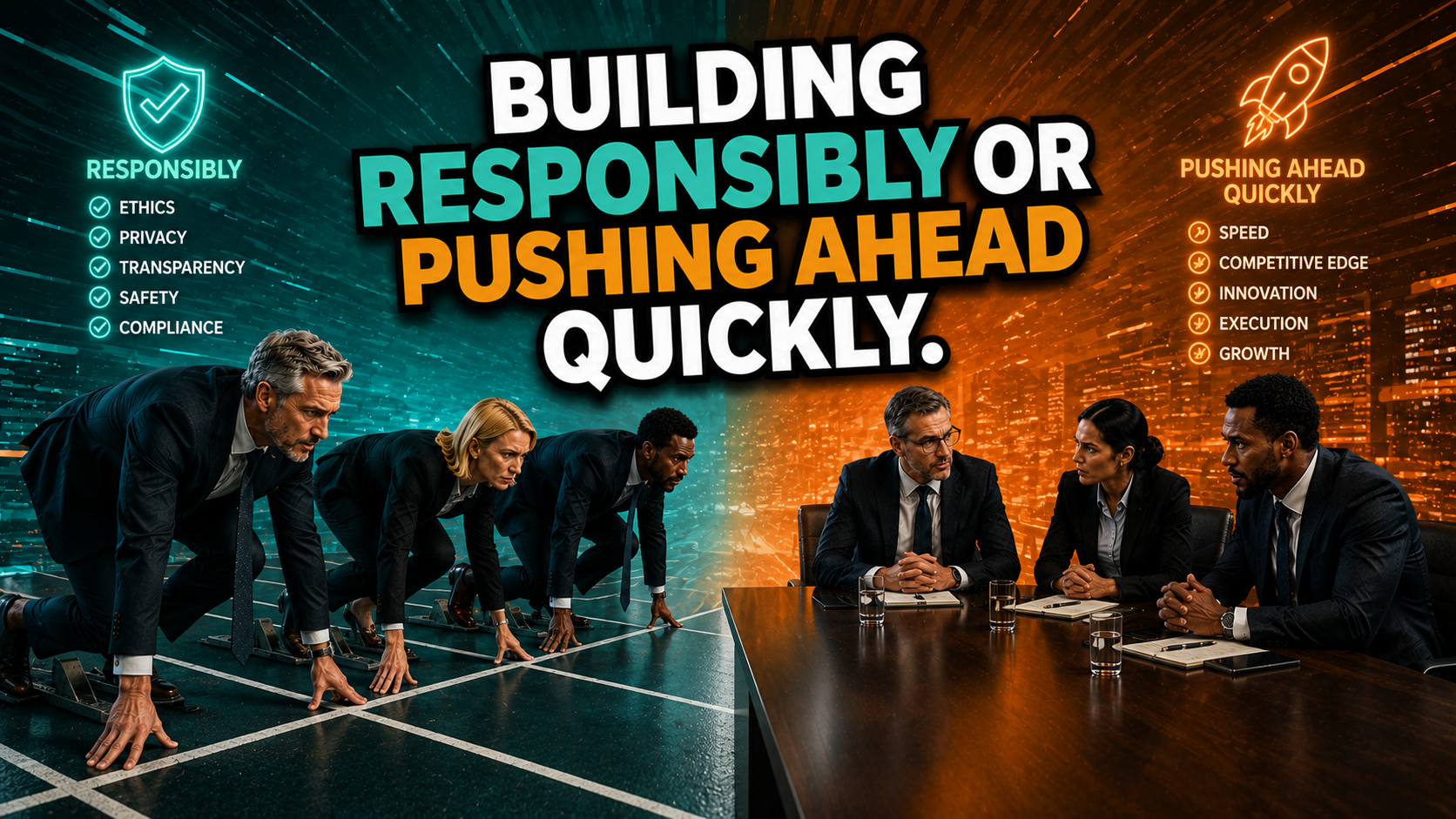

Why AI only scales when trust is built in from the start
Until recently, technology was guided by one dominant mantra: move fast and break things.
In the early days, this worked. Mistakes were inconvenient, but repairable. The impact was often limited.
With AI, this is fundamentally different.
The strategic question is therefore unavoidable: do we design AI responsibly from day one, or do we implement quickly and solve problems along the way?
This is no longer a philosophical discussion. It is a prerequisite for AI to scale at all.
AI earns the right to scale only when trust is designed into it from the beginning.
Responsible AI by design means building responsibility into AI, not adding it afterward.
Concretely, this means that an organization: defines ethical and legal frameworks before implementation
uses data that is controllable, relevant and lawful
demands transparency and explainability of AI output
explicitly organizes human oversight
Compliance, risk and legal functions are therefore involved from the design phase, not afterward. This may slow projects slightly at the start, but makes them far more stable when scaling.
Research shows that organizations with high AI trust ultimately move faster, because they face fewer blockages, fears and hesitations.
The alternative approach views AI primarily as an innovation accelerator.
The reasoning is familiar: let us just try it. If something goes wrong, we will fix it later. This feels entrepreneurial.
But with AI, “something going wrong” is rarely minor. Think of: discriminatory decisions
leakage of personal data
inappropriate or misleading customer communication
Once AI is involved in core processes, mistakes become visible, scalable and reputationally sensitive. Moreover, the more AI systems are live, the harder it becomes to trace and correct incidents afterward.
What initially delivers speed quickly turns into structural risk debt.
Because regulation enforces it.
The EU AI Act has been adopted and will gradually take effect through 2026. For many use cases, this means: mandatory risk management processes
logging and documentation
human oversight
Fines can reach up to six percent of global turnover. This makes a casual approach no longer viable.
But even beyond regulation, the risk remains. A single AI incident can destroy months of adoption and trust.
AI scales only when people, both internally and externally, dare to rely on it.
Choosing Responsible AI by design introduces additional but essential steps into AI driven processes: documentation of data and models
monitoring and logging of outputs
transparency toward end users
For example, a Copilot can show the sources behind its answers or explicitly label AI generated content as such. This prevents scenarios in which people blindly follow AI advice without knowing where it comes from.
In a speed first approach, these guardrails are often missing. AI output flows directly into decisions, with all associated risks.
Microsoft explicitly positions Responsible AI as a core principle. This is reflected in the platform:
Azure OpenAI does not use customer data for general model training
built in content safety and toxicity filters
logging, feedback mechanisms and monitoring
data loss prevention and governance features in the Power Platform
Organizations building on Microsoft receive much of the Responsible AI foundation by default.
But it still requires active design.
Responsible by design also means consciously deciding which sources a Copilot may use, which responses must be blocked, and where human confirmation is required.
Responsible AI is not a setting you turn on. It is a design choice.
AI ethics and risk are no longer IT details.
Audit and risk committees must explicitly ask questions such as: which AI risks are we facing
how do we mitigate them
who is ultimately accountable
Best practices show that leading organizations: establish AI ethics boards
assign clear accountability, such as CDO, CRO or Legal
make explicit policy decisions
Examples include: no AI without human override
AI generated content toward customers is always clearly identifiable
AI may not make HR decisions without human approval
These choices limit autonomy, but increase control and trust.
Responsible AI is not a brake on innovation. It is increasingly becoming a differentiator.
Customers, partners and regulators will compare AI usage on reliability, just as they now compare privacy and security practices.
Organizations that can demonstrate that their AI is safe, fair and explainable gain approval to scale more quickly. Those that cannot remain stuck in pilots or are slowed down by compliance.
The era of move fast and break things is coming to an end.
AI does not break features. It can damage trust, reputations and organizations.
Responsible AI is therefore not a luxury, but a licence to operate.
What feels like extra work today becomes the reason you dare to scale tomorrow when others get stuck.
Prevention is not a cost item here. It is the accelerator of sustainable AI value.
Or, as it truly applies in this context:
an ounce of prevention is worth a pound of cure.

 Old buildings in Norwich