AI makes it possible to embrace variation, but only when organisations are clear about what must remain predictable.
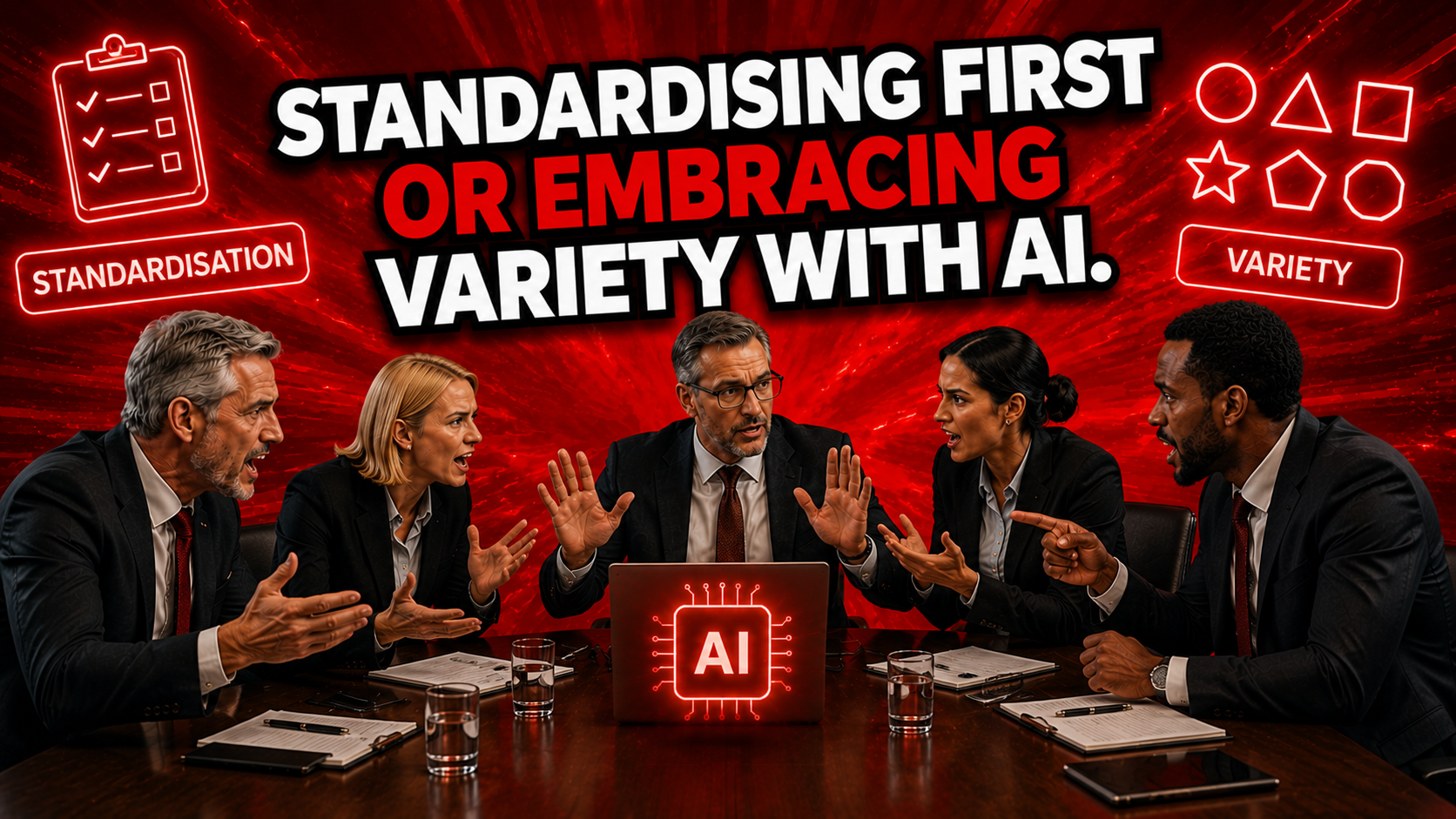

Every organization that starts working seriously with AI will eventually face the same question.
Do we first need to tightly standardise our processes before applying AI,
or can we use AI precisely to deal with existing variation and complexity?
For many years, the answer seemed obvious. The classical ERP mindset was clear: if you automate a messy process, you simply automate the mess. First harmonise, then automate.
AI fundamentally changes that playing field.
The traditional route is well known. Organizations invest first in uniform processes.
One way of working.
The same steps, forms and definitions.
Limiting exceptions and local variations.
This approach has long been a prerequisite for successful ERP implementations. The logic is straightforward: standardised processes generate consistent data, and consistent data is easier to analyse, automate and control.
Organizations with strong process discipline still see this advantage today. If there is one harmonised order process, AI can be applied relatively quickly. Something is trained once and works everywhere.
But this approach comes at a cost.
It takes time.
It creates resistance.
It often requires strong top down intervention.
And not every variation wants to or can be standardised away.
AI introduces a radically different option. Instead of fighting variation, organizations can choose to accept it and handle it intelligently.
Scenarios that previously seemed almost impossible become realistic.
Customers place orders via email, PDF, EDI or even spoken requests, and AI translates them into one structured order.
Departments use different terminology or sequences, and AI takes care of the mapping and interpretation.
Processes contain local exceptions, and an agent applies the correct logic per situation.
In this model, variation is no longer a problem, but an input. AI acts as a flexible buffer between messy reality and structured systems.
This promises the best of both worlds: flexibility and automation.
“AI allows organisations to stop forcing uniformity everywhere, but only if they consciously decide where flexibility truly adds value.”
Because AI technology has reached a tipping point. Traditional workflows fail when deviation occurs. An unexpected document, a missing field, an unusual path, and the process breaks down.
AI agents can handle this.
Where the old rule was exception equals human intervention, we increasingly see a new pattern: exception equals AI.
This opens strategic options.
Less forced standardisation.
More room for local or customer driven variation.
Still maintaining scale and speed.
But this is not a licence to abandon structure.
AI is not a miracle solution. If processes are fully chaotic, if data is fragmented, if nobody knows what is correct, AI will fail as well. Sometimes more subtly, but with greater consequences.
Research shows that only a small percentage of organizations consider their data mature enough to truly scale AI. Without a reliable foundation, a governance nightmare emerges: decisions that cannot be explained, unpredictable output and compliance risks.
The EU AI Act reinforces this even further.
The more variation you allow, the more you must be able to explain what happens and why.
That means you must consciously decide where flexibility is acceptable and where it is not.
If you choose standardisation before AI, you typically:
Start with process workshops.
Define a single way of working.
Roll out systems such as Business Central broadly with minimal variation.
AI then operates on a clean canvas. Outcomes become predictable and reliable.
If you choose AI as a manager of variation, you:
Allow existing differences to remain.
Design processes with explicit AI decision points.
Combine fixed workflows with intelligent agents.
The process design becomes more complex, but also more adaptive. Humans and AI collaborate in processes with multiple possible paths.
Microsoft applications have historically been built around best practice processes. Organizations that work out of the box receive a high degree of standardisation almost automatically.
AI driven variation management introduces something new.
Instead of heavy ERP customisation, more decision logic is delegated to AI agents. What previously required configuration or code can now become contextual intelligence.
Tools such as Copilot Studio and Process Advisor explicitly support this approach. They make it possible to identify where variation occurs and then decide deliberately whether to enforce uniformity or let AI handle it.
This choice directly touches leadership. Standardisation requires top down direction. Local autonomy must sometimes be sacrificed for uniformity, and that only works if the board actively supports it.
Using AI to manage variation demands a different mindset. It requires a willingness to give technology room to operate in unpredictable situations and to accept that learning sometimes involves mistakes.
Executives must explicitly determine:
Which processes must be predictable.
Where flexibility is a competitive advantage.
How much error tolerance is acceptable, and where.
Without this framework, initiatives conflict and the organization loses direction.
AI forces organizations to rethink process discipline. Not every deviation is bad. Not everything that is tight is smart.
The real question is not whether to standardise or not.
The real question is where we consciously standardise, and where we deliberately let AI carry variation.
Organizations that make this choice explicitly do not build rigid processes, but a flexible operating model that is both scalable and adaptive.
And that, more than anything else, determines whether AI becomes an accelerator or just another layer of complexity.

 Everyone building their own Copilot