AI creates value when fragmentation stops and direction begins.
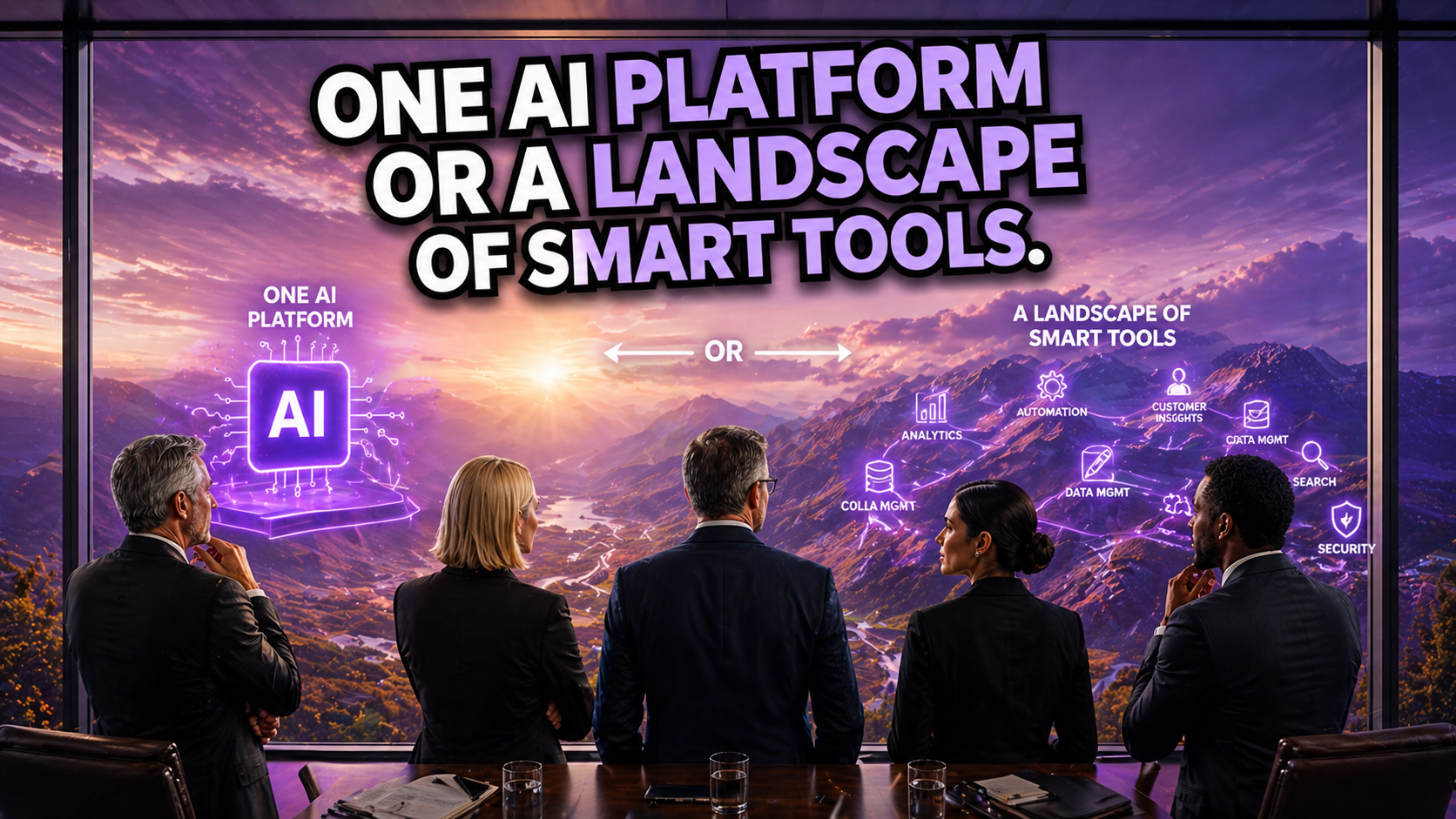

AI seems to be available everywhere today. For almost every problem, there is a smart tool, a startup, or a specialized solution. And that is exactly where a new strategic choice emerges.
Do we build our organization around one integrated AI platform,
or do we allow multiple standalone AI solutions to exist side by side?
At first glance, this appears to be a technical architecture question. In reality, it affects costs, governance, speed, trust and scalability.
“The more AI tools an organisation accumulates, the more important it becomes to consciously decide where coherence matters more than choice.”
An integrated AI platform, such as the one Microsoft positions, means working with a single data layer, a shared identity and security model, and a unified way in which AI appears in daily work.
Copilots in Microsoft 365, Dynamics 365, Power Platform and Azure OpenAI then work together as a coherent whole. The advantage is not merely technical, but experiential. AI follows context across workflows. From a Teams meeting to CRM. From email to order. From analysis to action.
Governance becomes manageable. Policies, security and compliance are centralized. Usage and risks are visible and monitorable.
For organizations that already operate primarily within the Microsoft ecosystem, this feels logical and efficient.
The downside is equally familiar: dependency on a single vendor and the concern of vendor lock‑in.
The alternative approach selects the best tool per domain.
A specialized vision AI solution for product recognition.
A niche supply chain AI for optimization.
ChatGPT or an open source model for generic interaction.
Alongside Microsoft Copilot for productivity.
In the short term, this can be attractive. Each solution excels at something specific.
But at organizational scale, friction quickly arises:
Data must constantly be synchronized between tools.
Users interact with multiple AIs that each have their own behavior and tone.
Governance is fragmented across platforms.
Integration costs turn out to be structurally higher than expected.
What starts as flexibility often ends as complexity.
We are currently in the platform formation phase of AI. After an explosion of point solutions, consolidation is underway. Large platform players are embedding AI deeply into their ecosystems.
The choice you make now will shape your IT and AI architecture for years to come.
If today you allow every department to independently purchase AI tools, within two years you will likely be dealing with an AI spaghetti that is difficult to untangle.
If you make an explicit platform choice now, you prevent opportunistic decisions later.
Not choosing is still a choice, but one without direction.
With AI, trust is critical. A majority of executives identify data privacy and security as the greatest AI risk.
Each additional AI solution: expands the attack surface
introduces new data streams
requires separate compliance validation
Microsoft positions Copilot explicitly as enterprise safe. Data stays within the tenant and models are not trained on customer data.
When multiple external AI solutions are added, this level of proof must be provided repeatedly to auditors, regulators and stakeholders.
Fewer tools make control simpler.
With one integrated AI platform, organizations can truly design AI first processes. A single Copilot accompanies users across Outlook, Teams, Dynamics and Power BI.
The AI sees the same data, works with the same context and speaks the same language.
With separate tools, siloed AI emerges. Users switch between different AIs depending on the task. This increases cognitive load, slows down work and undermines adoption.
AI should disappear into the flow of work, not become yet another tool.
Choosing multiple AI solutions means that integration must be explicitly designed.
This typically involves: integration layers
API management
iPaaS solutions
stronger enterprise architecture governance
Integration then becomes a permanent program with ongoing cost.
Historically, integration has almost always been more expensive than expected. AI is no exception.
Microsoft naturally hopes organizations choose its full stack. And indeed, that stack now covers a large part of enterprise AI needs.
At the same time, the platform is deliberately open.
Azure OpenAI can host open source models.
Power Platform offers connectors to external AI services.
Data remains accessible via APIs.
This enables a hybrid strategy: one primary platform, with extensions where needed.
For example: Microsoft is our default. External AI is used only when there is no suitable Microsoft alternative.
This approach provides both direction and flexibility.
This choice affects total cost of ownership, risk and compliance, innovation capability and vendor leverage.
It is therefore not a decision that should emerge at an operational level.
Boards must explicitly determine: what the standard AI platform is
when deviation is allowed
who decides on exceptions
Without such guidance, discussion repeats for every new use case, draining time and energy.
Every organization eventually moves toward consolidation. Just as ERP evolved from best of breed to suites, AI will likely follow a similar path.
Not because suites always offer the best features, but because consistency, trust and speed outweigh the last percentage point of optimization.
The key is not all or nothing, but one clear core platform with consciously justified exceptions.
AI is no longer a standalone tool. It is becoming a layer that runs through the entire organization.
And like any foundation, the calmer and more consistent it is, the more scalable everything built on top of it becomes.

 Standardising first or embracing variety with AI