AI succeeds where organisations choose to grow people, not replace them.
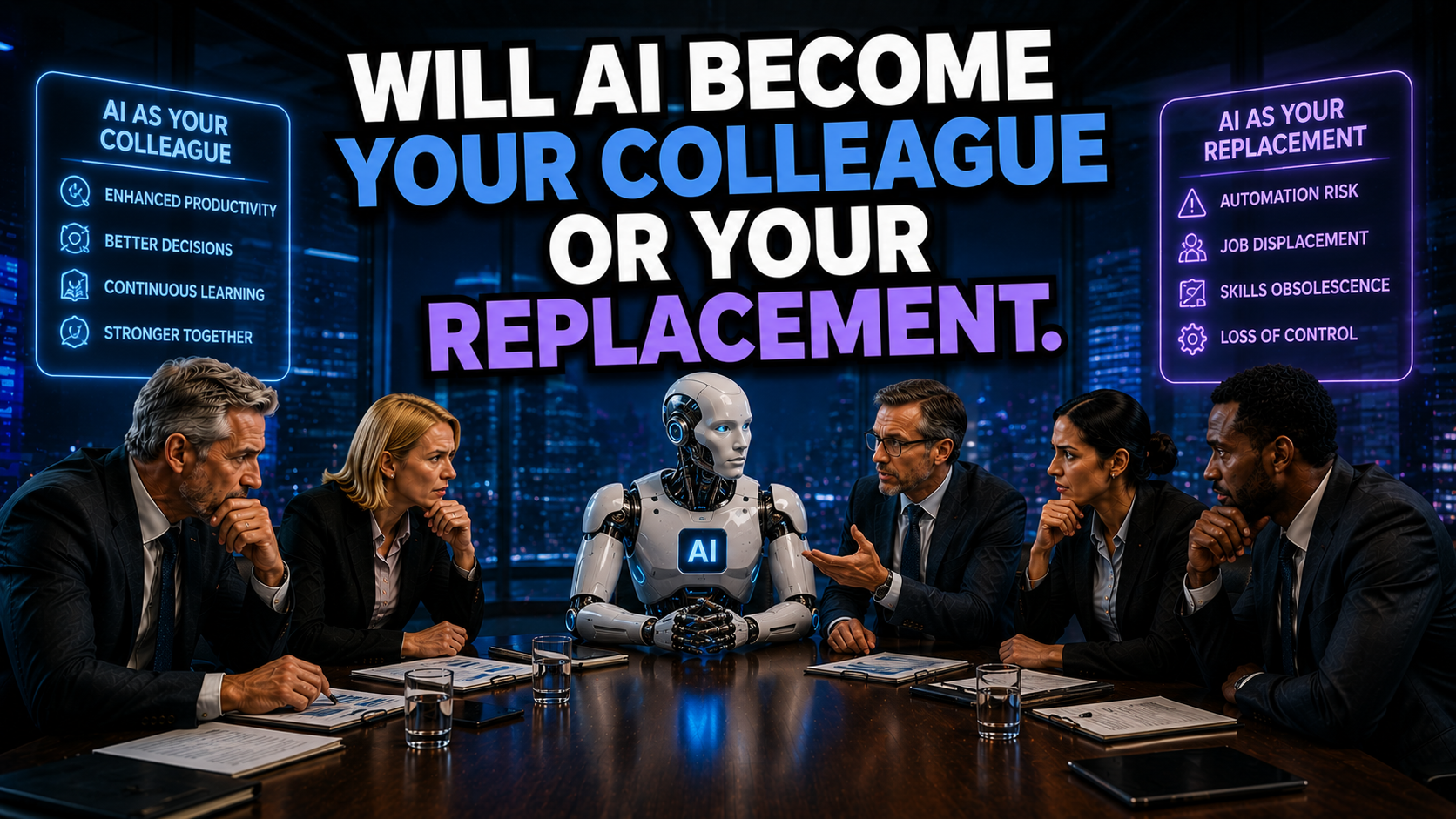

Why your view of people determines AI success
In many discussions about AI, the focus is on technology, data and processes. But beneath the surface lies a much more fundamental choice.
Do we see AI primarily as a way to strengthen people,
or as an instrument to replace human labour?
The difference may seem subtle. Its impact is enormous.
This choice affects organizational culture, HR policy, leadership and even how people behave once AI is introduced.
How an organisation talks about AI reveals whether it sees people as a cost to reduce or a capability to multiply.
In an augmentation driven approach, one principle is central: the combination of human and AI delivers more value than either could alone.
AI takes over routine work, allowing people to focus on complexity, creativity and relationships.
Examples are already widespread.
Lawyers use AI to scan contracts, while making the final judgment themselves.
Sales representatives let AI qualify leads and prepare pitches, giving them more time for real customer conversations.
Consultants use Copilots to quickly generate insights, while deciding what truly matters for the client.
Work changes, but does not disappear. People become more valuable.
Organizations that consciously choose this approach invest in: training and upskilling
new roles such as monitor, orchestrator and advisor
a culture where experimenting with AI is normal
AI is not perceived as a threat, but as a tool.
The alternative perspective looks at AI differently.
Here, AI is primarily seen as an opportunity to structurally replace human labour. Fewer FTEs. Lower costs. Higher margins.
Some leaders state this openly. They expect organizations to become significantly smaller thanks to AI.
In the short term, this can be attractive: direct cost savings
higher efficiency
clear, measurable ROI
But this path carries serious risks.
When AI is positioned primarily as a replacement, side effects often emerge.
Loss of implicit knowledge.
Demotivation among remaining employees.
Erosion of the talent pipeline.
A fundamental question is rarely asked explicitly.
If junior roles are automated away, who becomes your senior talent in ten years?
Behaviour also changes. Fear of job loss is one of the largest barriers to AI adoption. People do not sabotage AI intentionally, but they delay, avoid or minimise its use if they believe they are making themselves obsolete.
Because employees quickly sense the true intent.
If leadership says “AI is here to help,” but every productivity gain is followed by headcount reduction, trust disappears immediately.
Research shows that many employees already believe AI will mainly be used to replace them. As an executive team, you must either actively counter this perception or explicitly confirm it.
Not choosing is not a neutral position.
It determines: the speed of AI adoption
how openly people experiment
whether AI creates energy or resistance
Choosing augmentation means deliberately designing processes with human oversight. AI performs preparatory work. Humans continue to decide, interpret and control.
This requires: redefining roles
adjusting job profiles
investing in AI related skills
Upskilling becomes a strategic priority, not an HR side activity. Prompting, data interpretation and collaborating with AI become part of the profession.
Processes do not disappear. They transform. Less execution, more judgment. Less manual work, more direction.
Choosing replacement leads to very different process designs.
Maximum automation.
Minimal human intervention.
Strong focus on standardisation and scale.
Examples include fully self service customer channels or agents that also handle exceptions.
HR implications become significant: which roles disappear
through which route attrition, reskilling or redundancy
how critical knowledge is preserved
These are difficult decisions that require strong communication and leadership.
Microsoft positions Copilots primarily as augmentation tools. The message is clear: Copilot works for you.
However, the technology itself is neutral. The same tools can be used for empowerment or elimination.
The difference lies not in the platform, but in how it is applied and what is measured.
An augmentation oriented organization: provides broad Copilot access
invests in adoption and skills
uses productivity gains to create new value
A replacement oriented organization: focuses on automation infrastructure
limits end user tooling
steers primarily on FTE reduction
This is ultimately a leadership question.
The CEO must present a credible story about how people and AI create value together.
What happens with time that is freed up
How the organization invests in its people
How AI gains are reinvested or harvested
That story must be consistent with behavior.
If leaders say AI is meant to help but immediately convert gains into cost cuts, employees quickly learn the real message.
If leaders reinvest gains into training and growth, trust emerges.
Organizations that automate too aggressively often create a future problem.
They remove the very pipeline through which new talent develops.
An augmentation approach can do the opposite. Juniors can grow faster because routine work disappears and more complex tasks become accessible earlier.
AI can accelerate development, instead of slowing it down.
AI is not just a technological choice. It is a reflection of how you view people.
Do you see people as a cost to be replaced, or as a capability to be multiplied?
A large share of AI success is determined by people and skills, followed by processes and culture. Algorithms matter least.
Organizations that understand this see AI transformations that are embraced. Those that ignore it discover that even the most advanced AI stalls on fear and lost trust.
This choice belongs to leadership. And its consequences will be felt for years to come.

 Why the Model Context Protocol changes how AI agents work