Organizations that consciously make this distinction today are not just building smart tools, but a future ready operating model.
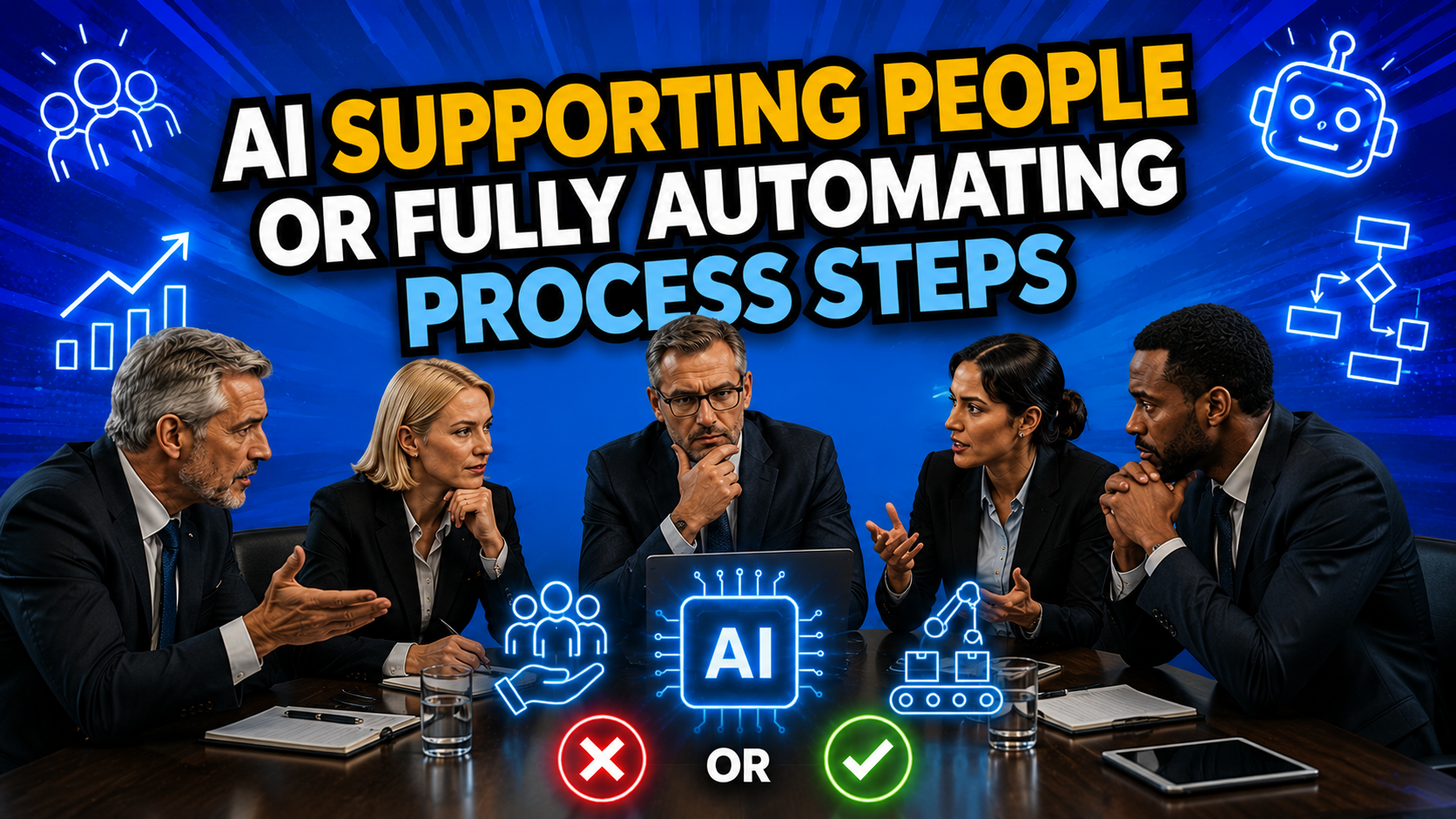

Many organizations today say they are “using AI in their processes.” But when you look more closely, a fundamental difference emerges in how AI actually participates.
In one organization, AI supports people. It makes suggestions, summarizes information and generates proposals. In another organization, AI increasingly executes process steps itself, without direct human action.
At first glance, this may seem like a gradual difference. In reality, it is a strategic choice that determines how you design processes, roles and accountability.
The question is simple, but uncomfortable:
Do you want AI to think along with people, or do you allow AI to act independently?
“The moment AI starts acting instead of advising, responsibility no longer shifts to technology, but to the organisation that designed the process.”
In a Copilot driven model, the human remains the primary actor in the process. AI supports, accelerates and enriches, but does not make final decisions.
Examples are already widespread today.
In Dynamics 365 Sales, a salesperson automatically receives a draft proposal based on customer data and previous deals. The salesperson reviews, refines and sends it.
A service agent receives suggested responses and relevant knowledge articles while composing an email. The employee chooses what fits best.
A controller sees anomalies in figures flagged by AI, but decides personally which follow up actions are required.
This model feels safe and familiar. It builds on existing processes while making people more productive.
More importantly, it changes the role of employees without automating them away. From executor to reviewer. From typist to decision maker.
Here, AI is not a replacement, but a true Copilot. The human remains ultimately responsible.
The other extreme is fundamentally different. In this model, you allow certain process steps to be executed entirely by an AI agent, without a human having to check or click each time.
Examples include:
A Sales Order Agent in Business Central that automatically registers, checks and confirms incoming orders.
A service agent that creates cases, classifies them, sends follow up messages and closes them, with escalation only in exceptional situations.
A planning agent that continuously replans based on disruptions, without manual recalculation.
The human does not disappear here, but moves to the edges of the process.
No longer touching every order, but instead: handling exceptions
monitoring quality
evaluating patterns and outcomes
This delivers enormous scalability. Agents operate around the clock, in parallel and consistently within defined boundaries.
But something fundamental also shifts. The organization becomes responsible for AI decisions. Not “the employee clicked something,” but “this process was designed this way.”
Until recently, this discussion remained largely theoretical. That phase is over.
Microsoft has released multiple prebuilt autonomous agents within Dynamics 365. Copilot Studio allows organizations to build their own agents that can take actions across several systems.
Technologically, it is possible. The real question is whether organizations dare to adopt this structurally.
Any organization deploying agents must be able to answer questions such as:
Which steps may operate fully autonomously?
What is an acceptable error margin?
When must a human intervene?
Who is ultimately accountable if something goes wrong?
These are not IT questions. They are executive questions.
If you choose Copilot support, you design processes with deliberate human decision moments. AI informs, accelerates and enriches, but every critical point remains a human choice.
If you choose agent automation, you design processes around exception management. AI handles the default path. Humans oversee deviations.
This requires: clear escalation rules
transparency into what the agent has done
monitoring, logging and auditability
An agent without visibility is not efficiency, but risk.
What is interesting is that Microsoft does not force a single approach. The platform is explicitly designed for combinations.
Copilots that support people in daily work.
Agents that autonomously execute specific steps.
Workflows that determine when AI takes over and when humans do.
This hybrid approach is not a compromise. It is often the most realistic route. Not every process is suitable for full autonomy, but nearly every process contains components that are.
The biggest mistake organizations make today is not making a choice at all.
Implicit decisions then emerge: a Copilot here
a standalone agent there
without a coherent framework
The result is uncertainty among employees, questionable risks and missed scalability.
Executives must provide explicit direction: Where do we consciously keep humans in control?
Where may AI act autonomously?
What does this mean for governance, compliance and roles?
Not to slow innovation, but to accelerate it responsibly.
Copilots make people better. Agents make processes scalable.
But they require fundamentally different choices. About trust. About accountability. About how you design your organization.
Letting AI think along is comfortable. Letting AI act is transformative.
Organizations that consciously make this distinction today are not just building smart tools, but a future ready operating model.

 One AI platform or a landscape of smart tools