AI does not transform organisations by being added. It transforms them when it becomes part of how work actually flows.
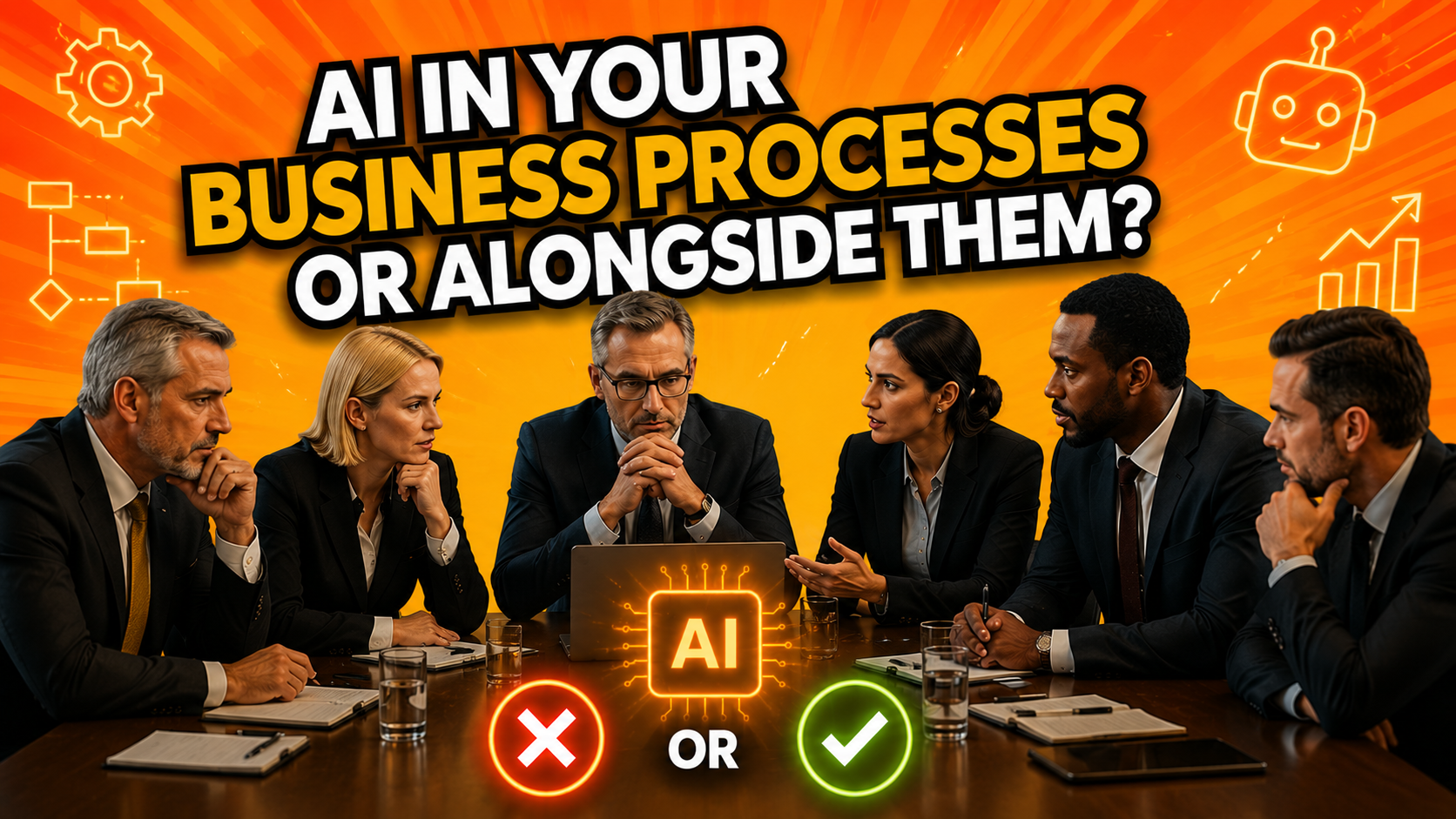

Many organizations say today: “We are working with AI.” But when you look more closely, AI often still functions as a separate aid rather than as an integral part of the way work is done. A chatbot next to the CRM. A prompt tool outside the ERP. A smart analysis in a dashboard, without any real impact on the daily flow of work.
And that is exactly where a fundamental strategic choice arises, one that every organization must now make.
Does AI become an integral part of your business processes, or does it remain a loose assistant alongside your existing way of working?
This is not a technological nuance. It is a choice that defines your operating model.
Choosing to embed AI directly into processes means turning process design around. You no longer ask “Where can we add AI?” but rather “What would this process look like if AI were involved by default?”
In an AI‑integrated process, AI is not a helper on the sidelines, but an active participant. A few examples make this tangible.
In the sales process, a proposal is no longer manually created in Word. Instead, it is generated by a Copilot inside Dynamics 365 Sales, based on customer data, pricing agreements and previous deals. The sales representative fine‑tunes and approves.
In the service process, a case is automatically analyzed. AI recognizes the problem type, retrieves relevant knowledge articles and already drafts a proposed solution, all within the CRM system.
In planning and supply chain, AI produces the first planning, while the human focuses on exceptions, risks and decisions.
The human remains essential, but the process itself changes. AI becomes a fixed team member that participates in every order, every case and every workflow.
This goes far beyond implementing a tool. Organizations that take this step often discover that roles blur, handover moments disappear and processes become shorter and smarter. The operating model shifts toward humans and AI working together as one system.
Opposite this stands AI as a loose assistant. The existing process remains unchanged, and AI is allowed to “help” without truly influencing how work flows.
Again, some examples clarify this.
A sales representative still builds everything manually, but occasionally asks an AI tool outside Dynamics 365 Sales for text suggestions.
A buyer follows the same workflow as before but checks a separate AI tool from time to time.
Employees copy data between systems and external AI tools.
This approach feels accessible and quick. Little needs to change. But precisely that is its limitation. AI stands next to the process, not inside it. It rarely leads to structural improvement and often results in extra steps rather than progress.
AI feels like additional work instead of acceleration.
The experimental phase is over. AI has become production technology. Where organizations were once satisfied with pilots and proof‑of‑concepts, it is now evident that isolated AI experiments rarely deliver lasting value.
Real impact only emerges when AI is embedded in core processes.
At the same time, technology is no longer the bottleneck. Enterprise platforms are ready. Built‑in Copilots in applications like Dynamics 365 Sales and Business Central have matured. The barrier is organizational, not technical.
The crucial question is whether organizations dare to redesign their way of working around AI capabilities.
Organizations that do so see clear effects: shorter lead times, fewer errors, more consistent work and more room for human focus on exceptions and customer value.
Organizations that remain stuck with loose AI tricks often experience the opposite: lots of energy, little return.
Embedding AI directly into processes requires that processes are truly digital and system‑driven. You cannot integrate a Copilot into a process if people still work largely outside the system.
Concretely, this means:
Processes must be explicitly supported by systems such as CRM and ERP.
KPIs need to be redefined, not only measuring output per employee, but performance of human and AI together.
Roles evolve from execution toward supervision, orchestration and decision‑making.
Gartner refers to this as “co‑human workflows”: processes redesigned around collaboration between human and AI, not as an exception but as the norm.
If AI is kept outside these processes, other patterns emerge. Employees switch between tools. Data is copied and pasted. Privacy and governance risks increase. Opportunities for real automation are missed.
Microsoft explicitly drives toward AI embedded in the flow of work. Its software portfolio is designed to place AI inside workflows, not beside them.
This enables scenarios where a fixed process automatically invokes an AI agent when it encounters an exception, allowing the process to continue dynamically instead of failing.
AI decisions become part of transactions and process history. This only works when AI resides in the core platform.
If it does not, shadow IT emerges. Employees turn to external AI tools outside IT visibility, without governance and without structurally capturing the value that AI produces.
This decision requires leadership. Making AI an integral part of processes means explicitly stating that processes will be designed AI‑first.
It requires investment in platforms and change management. KPIs and incentives need to change. Experiments must be evaluated based on their contribution to core processes.
For executives, this is not a technical decision but an organization‑wide course setting.
For CIOs and CEOs, it means less focus on isolated AI gadgets and more focus on structural improvement of core processes.
AI that sits next to your organization changes little. AI that is embedded in your processes changes everything.
This choice, made consciously and explicitly now, determines whether AI remains a nice tool or grows into a structural part of how your organization creates value.
And that is precisely why this is the first choice every organization must make.

 Using AI to reduce costs or create value